
 |
| Image Credit : Marvel Studios |
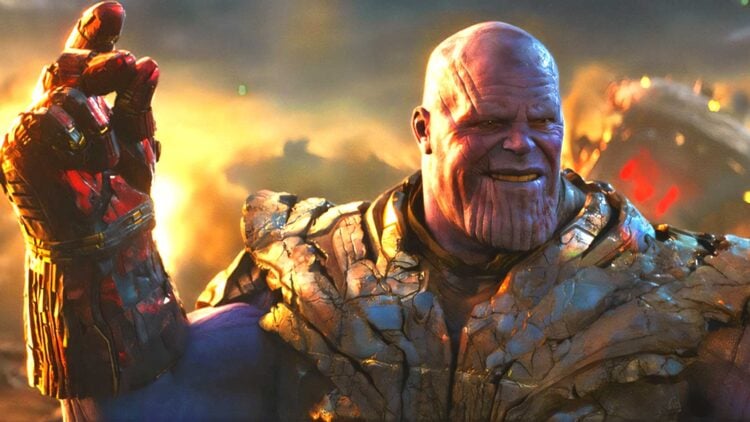
Marvel’s most iconic villain is Thanos—a name that every Marvel fan knows. He is widely considered the most powerful villain in the Marvel Cinematic Universe (MCU), which makes it surprising to realize that the version we saw in the movies was actually weaker than his full potential.
Unlike many villains who appear in a single film and disappear, Thanos was built up over nearly a decade so that when he finally took center stage in Avengers: Infinity War, his threat level felt massive. And it truly was—defeating him required the combined efforts of the entire Avengers team, along with the use of time travel. Even then, the heroes were essentially fighting a less powerful version of Thanos, and still struggled immensely.
Thanos is best known for wielding the Infinity Stones, which he used to wipe out half of all life in the universe. But even without them, he was incredibly powerful. He defeated Hulk in a one-on-one fight and destroyed the home planet of the Nova Corps with his army. His immense strength and combat skills alone made him a formidable opponent for any hero.
However, realistically speaking, Thanos could have been even more powerful, as several of his abilities were not fully explored in the MCU.
Before discussing his powers further, it’s important to understand his connection to the Eternals. In Eternals, this group of god-like beings is shown to be the result of experiments conducted by the Celestials on early humans. These experiments created artificial lifeforms known as Eternals, who can even be replaced if they die.
At the end of the film, a new Eternal named Eros appears and reveals that he is Thanos’ brother. This creates confusion, because if Eternals are artificially created, the idea of them being “brothers” doesn’t fully make sense. Also, if Thanos is an Eternal, his drastically different appearance raises questions.
In comic lore, Eros and Thanos come from a colony of Eternals on Titan. But in the MCU-style explanation, Thanos’ condition is often linked to something called “Deviant Syndrome.” According to Marvel Anatomy: A Scientific Study of the Superhuman (an in-universe styled book attributed to T'Challa and Shuri), Thanos inherited a gene that caused extreme physical changes in his body. This Deviant gene explains his purple skin, immense strength, large physique, and iconic chin, making him look very different from other Eternals.
Thanos’ appearance is the most obvious effect of this Deviant Syndrome, but the MCU doesn’t fully explore its other symptoms as much as the comics do. According to the same source, the comic version of Thanos is far more powerful than the MCU version.
In the comics, Thanos possesses a rapid healing factor, allowing him to recover from severe injuries and even return from death multiple times. However, in the MCU, this ability is never clearly shown—his death and return are explained through time travel rather than biological regeneration.
Additionally, Deviant Syndrome gives Thanos a unique connection to cosmic energy. In the comics, he can absorb cosmic energy and release it as powerful blasts from his hands and eyes. This makes him far more dangerous, as his abilities go beyond just physical strength.
This cosmic energy also allows him to survive in space without oxygen. T'Challa even suggests that Thanos may have a unique nervous system capable of channeling cosmic energy—though this idea is never explored in the MCU.
Many of these powers were likely omitted because the concept of the Eternals had not yet been fully introduced when Avengers: Infinity War and Avengers: Endgame were made. Still, from a fan perspective, it feels disappointing that some of Thanos’ most impressive comic abilities were not included, because his on-screen version—already incredibly powerful—could have been even more terrifying.
Even so, many fans would love to see Marvel bring back Thanos in the future, perhaps in a new form. After all, without an extremely powerful villain, the Avengers wouldn’t truly feel challenged.


